How to Spot and Avoid Crypto Giveaway Scams
If you receive an unexpected crypto airdrop or giveaway link, do not click it. Here is how scammers hijack social media and digital wallets to drain your funds, and how to protect your keys.
On this page
- Read time5 min
- Data tables1
- StatusResearch updated 2026-09-24
What to Do in the Moment
If you encounter a suspicious giveaway or receive an unexpected token airdrop, take these immediate steps:
- Do not click any links: Avoid clicking URLs embedded in social media comments, direct messages, or transaction memos, as they may lead to phishing sites or download malware [FTC Social Media], [IC3 Hedera PSA].
- Verify independently: If a promotion appears to come from a known brand or public figure, navigate to their official website or verified customer service channel independently to confirm the offer [FTC Social Media]. Do not use the contact details provided in the suspicious message [FTC Prize Scams].
- Keep your wallet disconnected: Never link your non-custodial wallet to a website or dApp unless you have thoroughly verified the platform's legitimacy [IC3 Hedera PSA].
How the Scam Works
Cryptocurrency giveaway scams rely on a simple, powerful psychological trigger: the promise of free money. Scammers deploy these schemes across social media, messaging apps, and directly inside digital wallets to trick you into giving up control of your assets.
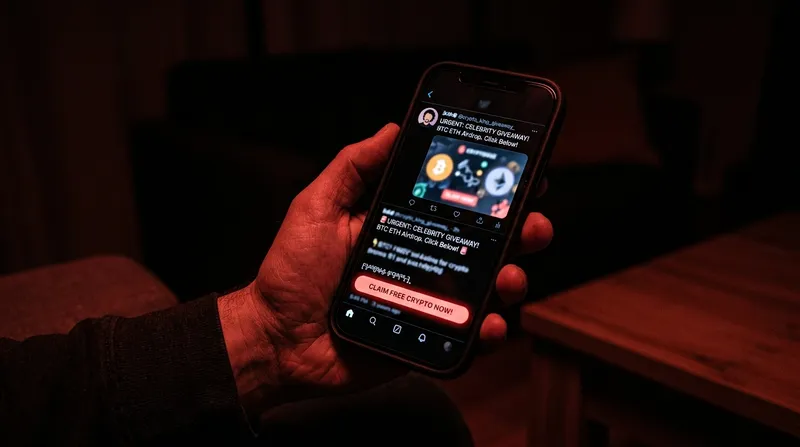
In a typical social media giveaway scam, bad actors hijack or clone the profiles of legitimate businesses or public figures [FTC Social Media]. They post promotions claiming they will multiply any cryptocurrency you send them, or offer expensive prizes like gift cards and electronics [FTC Investment Scams], [FTC Prize Scams]. Once you engage, they direct you to a link where you are asked to pay a "processing fee" or input your wallet credentials to claim your reward [FTC Prize Scams].
More advanced technical variations target non-custodial wallets directly. For example, on networks like the Hedera Hashgraph, scammers exploit the nonfungible token (NFT) airdrop feature [IC3 Hedera PSA]. Victims receive unsolicited tokens accompanied by a plaintext "memo" containing a malicious URL. Clicking this link prompts you to connect your wallet to a decentralized application (dApp), which then requests your private login credentials or seed phrase [IC3 Hedera PSA]. Once entered, the scammer gains full access and drains the wallet [IC3 Hedera PSA].
The Numbers: Escalating Fraud Losses
According to federal reporting, cyber-enabled fraud has reached unprecedented levels. The FBI’s 2025 Internet Crime Report revealed that internet crimes defrauded Americans of nearly $21 billion, with cryptocurrency complaints representing the costliest category [FBI 2025 Report]. Over 181,000 cryptocurrency-related complaints were submitted, totaling more than $11 billion in losses [FBI 2025 Report].
Imposter scams (which include scammers pretending to be businesses, banks, or government agencies) accounted for $3.5 billion in reported losses in 2025 [FTC Imposter Data]. These scams frequently start with fake security alerts or social media promotions designed to convince victims to move funds [FTC Imposter Data].
Red Flags of a Giveaway Scam
To protect your digital assets, watch for these critical warning signs:
- Upfront Fees: Any promotion that requires you to send cryptocurrency, pay "taxes," or cover "shipping and handling" to receive a free prize is a scam [FTC Prize Scams]. Real prizes are free [FTC Prize Scams].
- Requests for Seed Phrases or Private Keys: No legitimate business, government agency, or wallet provider will ever ask for your wallet's seed phrase or private key [IC3 Hedera PSA].
- High-Pressure Tactics: Scammers create a false sense of urgency, telling you that you must "act now" or lose the opportunity [FTC Prize Scams].
- Unsolicited Wallet Deposits: Receiving unexpected tokens or NFTs in your wallet with instructions in the transaction memo to visit an external website is a primary indicator of a wallet-draining scheme [IC3 Hedera PSA].
If You Already Sent Funds: Reporting Steps
Because cryptocurrency transactions are recorded on public ledgers, they are irreversible [FTC Crypto Scams], [IC3 Crypto Info]. Traditional financial protections do not apply, and the government cannot retrieve your funds [FTC Crypto Scams]. However, reporting the incident immediately is vital for law enforcement tracking.
If you have been defrauded, follow this containment and reporting sequence:
- Secure your remaining assets: If you shared your seed phrase or private key, contact your account providers immediately to regain control of your accounts, change passwords, and place alerts on your accounts [IC3 Hedera PSA].
- Document the details: Collect all transaction information, including:
- The exact cryptocurrency addresses involved [IC3 Crypto Info].
- The transaction hash (ID), which is typically a 64-character hexadecimal string [IC3 Crypto Info].
- The amount and type of cryptocurrency sent [IC3 Crypto Info].
- The dates, times, and communication platforms used [IC3 Crypto Info].
- File official reports: Submit your complaint to the FBI's Internet Crime Complaint Center at ic3.gov [FBI 2025 Report] and to the FTC at ReportFraud.ftc.gov [FTC Imposter Data].
- Avoid recovery scams: Be highly skeptical of individuals or services claiming they can recover lost cryptocurrency for an upfront fee [IC3 Hedera PSA], [IC3 Crypto Info]. These are almost always secondary scams targeting previous victims [IC3 Hedera PSA].
Three Defenses to Implement Today
To secure your digital assets against future giveaway and phishing schemes, implement these three practices:
| Defense Strategy | Action Required | Why It Works |
|---|---|---|
| Isolate Your Keys | Never enter your seed phrase or private keys into an unsolicited website or dApp [IC3 Hedera PSA]. | Prevents malicious dApps and phishing sites from gaining direct access to your wallet [IC3 Hedera PSA]. |
| Ignore Unsolicited Tokens | Treat unexpected airdrops as active phishing attempts. Do not interact with them or click memo links [IC3 Hedera PSA]. | Neutralizes the primary vector used to compromise non-custodial wallets [IC3 Hedera PSA]. |
| Verify Before Connecting | Always search the name of any platform alongside "scam" or "complaint" before linking your wallet [FTC Investment Scams]. | Helps identify known fraudulent domains and malicious smart contracts before authorization. |
Who Is Most at Risk?
While anyone can fall victim to these schemes, federal data highlights specific vulnerable demographics. FTC data shows that younger adults (ages 20-49) are significantly more likely to report losing money to cryptocurrency investment scams, with those in their 20s and 30s reporting cryptocurrency as their highest source of investment fraud losses [FTC Investment Scams].
Conversely, older adults face severe financial impacts from broader imposter and cyber-enabled fraud. Americans over 60 reported approximately $7.7 billion in total losses to the IC3 in 2025, representing a 37% increase from the previous year [FBI 2025 Report]. This underscores the necessity of multi-generational awareness campaigns, such as the federal "Never Ever" initiative, to educate consumers on the tactics used by impersonators [FTC Imposter Data].
Quick Answers
Can a legitimate cryptocurrency giveaway require a fee?
No. Legitimate sweepstakes and prizes are entirely free [FTC Prize Scams]. If you are asked to pay cryptocurrency, taxes, or processing fees to claim a reward, it is a scam [FTC Prize Scams].
What should I do if I receive an unexpected token in my wallet?
Do not interact with the token, and do not click any links or URLs listed in the transaction's memo section [IC3 Hedera PSA]. Simply leave the token alone; interacting with associated links can compromise your wallet [IC3 Hedera PSA].
Can the government help me recover stolen cryptocurrency?
No. Cryptocurrency accounts are not backed or insured by the government [FTC Crypto Scams]. Because blockchain transactions are irreversible, funds can generally only be returned if the recipient chooses to send them back [FTC Crypto Scams].
Sources and research notes
Research checked 2026-09-24. Source comparison; this is a research synthesis. Findings attributed to other reviewers remain their work.
- Cryptocurrency and AI Scams Bilk Americans of Billions — FBI
- FTC Data Show People Reported Losing $3.5 Billion to Imposter Scams in 2025 | Federal Trade Commission
- Beware Cryptocurrency Scams - Mass.gov
- Spotting cryptocurrency investment scams | Consumer Advice
- Slow your scroll: Spot and avoid social media giveaway scams | Consumer Advice
- Internet Crime Complaint Center (IC3) | Cyber Criminals Defraud Hedera Hashgraph Network Non-Custodial Wallet Users Through Nonfungible Token Airdrops Disguised as Free Rewards
- What To Know About Cryptocurrency and Scams | Consumer Advice
- Fake Prize, Sweepstakes, and Lottery Scams | Consumer Advice
- Cryptocurrency - Internet Crime Complaint Center (IC3)
What the evidence does not establish
- The article relies on historical data up to 2025 and early 2026 from the FBI and FTC. Current live rates and active scam volumes may vary.
- Cryptocurrency recovery is extremely rare due to the irreversible nature of blockchain transactions; reporting is for law enforcement tracking rather than guaranteed recovery.
Keep reading
 Scam alerts
AI Voice Clone Scams: How to Protect Your Family from "Mom, It's Me" Schemes
Learn how scammers use AI voice cloning to mimic your loved ones in fake emergency scams, and get practical steps to protect your family.
 Scam alerts
Bank-Impersonation Call + SMS Scams: How to Protect Your Accounts
Bank impersonators use spoofed numbers and urgent text alerts to drain accounts. Learn the red flags and the immediate steps to secure your money.